Too many Glendale projects rely on pocket penetrometer readings alone, then wonder why their retaining wall tilts after the first heavy rain. The San Rafael Hills and the Verdugo Mountains shed runoff that saturates alluvial fans fast, and that means undrained loading conditions control most residential cuts. We run the triaxial test to get the effective stress parameters—c' and φ'—that actually govern shear strength when the ground gets wet. For the mixed colluvium found in neighborhoods above Glenoaks, a single unconfined compression value is never enough; we pair the consolidated-undrained stage with spt-drilling profiles to map the transition from stiff weathered shale to intact bedrock, and that combined dataset lets the structural engineer size footings with real confidence.
A single undrained triaxial stage on a saturated Glendale hillside sample can change the required footing embedment by over two feet—ignoring it means designing blind.
Scope of work in Glendale California
Risks and considerations in Glendale California
The difference between a site near Brand Park and one in the flatlands south of Colorado Street is night and day. Brand Park sits on steeply dipping Topanga Formation sandstone; triaxial tests there usually show a friction angle above 35 degrees and a cohesion intercept that drops fast with wetting. South of Colorado, the old alluvium can look competent in a split spoon but yields a fully softened friction angle below 27 degrees once we run the multi-stage triaxial procedure. Builders who treat both areas the same end up with foundation settlements that crack stucco within the first two rainy seasons. Our lab sees this pattern every year: samples arrive after the damage is done, and the triaxial data explain exactly what went wrong. A pre-construction test costs a fraction of the repair.
Our services
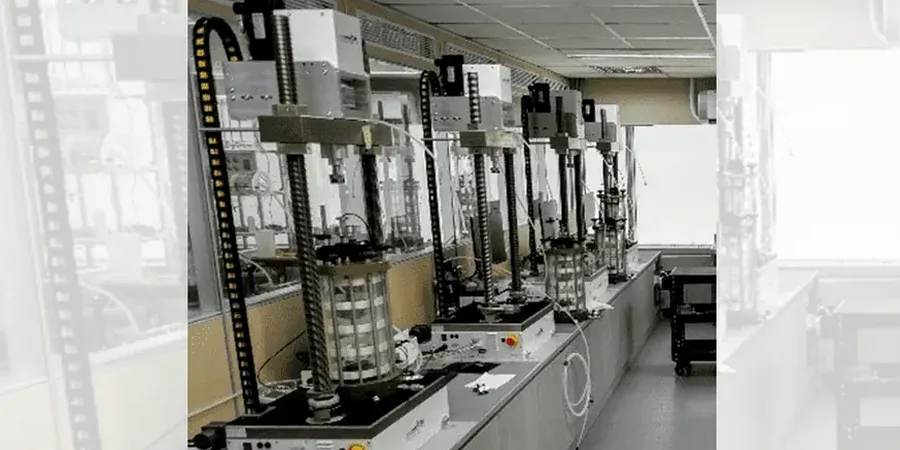
We run the triaxial test as part of a broader geotechnical characterization package for Glendale projects. The following services are often contracted together to build a complete ground model:
Consolidated Undrained Triaxial (CU) with pore pressure measurement
Three-stage test on saturated specimens to define the Mohr-Coulomb failure envelope in effective stress terms. We plot p-q diagrams, stress paths, and axial strain versus deviator stress for direct use in finite element models of Glendale hillside cuts.
Unconsolidated Undrained (UU) Triaxial for rapid loading scenarios
Quick undrained shear for saturated fine-grained soils where construction loading occurs faster than dissipation. We apply this protocol to trench backfill samples from Glendale Water & Power projects and emergency repair excavations.
Common questions
What does a triaxial test on Glendale colluvium cost?
For a single consolidated-undrained triaxial test on an undisturbed specimen, our fee ranges from US$1.730 to US$2.410 depending on the number of confining stages and whether we need to run a companion consolidation test. Multi-stage programs or projects requiring several specimens reduce the per-test rate.
Which triaxial variant is required for Glendale hillside construction?
The Glendale Building & Safety division typically wants consolidated-undrained (CU) parameters with pore pressure measurement for cut slopes steeper than 2:1. We confirm the requirement with the project geotechnical engineer, but in practice nearly every Verdugo foothills job needs effective stress c' and φ'.
How do you obtain undisturbed samples for triaxial testing in Glendale?
We push thin-walled Shelby tubes in boreholes advanced by hollow-stem auger or mud rotary. In the harder Topanga Formation, we may need a pitcher barrel. Samples are sealed with wax, transported upright inside temperature-controlled coolers, and extruded in the lab within 72 hours to preserve in-situ moisture and structure.
Can the triaxial test help with liquefaction assessment in Glendale?
The cyclic triaxial test, which we perform under ASTM D5311, directly measures the number of cycles to liquefaction for saturated sands and silty sands. While downtown Glendale sits on denser alluvium, pockets of loose fill along the old Verdugo Wash alignment warrant cyclic testing if the design earthquake magnitude exceeds M6.7.