Designing piles in Glendale is never a one-size-fits-all exercise. Move from the dense residential grid south of Glenoaks Boulevard up into the Verdugo Mountains above Brand Park, and the bearing stratum shifts from soft Holocene alluvium to fractured granitic bedrock within half a mile. In the valley floor, we routinely encounter 20 to 40 feet of compressible silts overlying the Lakewood Formation before reaching competent material—depth ranges that make shallow footings a gamble and push the design straight into deep foundation territory. The city's position just north of the Raymond Fault and less than 5 miles from the Hollywood Fault means every pile group we size must carry not only axial dead and live loads but also the kinematic demands of a Maximum Considered Earthquake, something the IBC Chapter 18 and ASCE 7-16 Chapter 12 make non-negotiable. Our team cuts through that complexity with a workflow that pairs field data from spt-drilling boreholes with lab shear strength envelopes to model skin friction and end bearing for both driven H-piles and cast-in-drilled-hole shafts, giving the structural engineer a foundation that actually matches the ground it sits in.
In Glendale's alluvial basin, the difference between a pile that settles 1 inch and one that settles 6 inches is often just 3 feet of additional embedment into the Pleistocene formation.
Scope of work in Glendale California
Risks and considerations in Glendale California
Glendale's microclimate adds a layer of risk that catches out-of-town designers off guard. The southern half of the city sits on the flat alluvial plain of the Los Angeles River, where groundwater perched on low-permeability lenses can rise 8 feet between a dry August and a wet February, completely changing the effective stress profile you used in the original pile capacity calc. Meanwhile, hillside neighborhoods like Brockmont and Chevy Chase Canyon sit on thin colluvial veneers over weathered granodiorite—material that drills easily but offers wildly variable bond strength for rock-socketed shafts depending on fracture spacing and infill clay content. The worst-case scenario we plan for is a deep-seated landslide mass moving at creep velocity under a row of piles, generating downdrag and bending moments that exceed the structural capacity of the pile section if not explicitly accounted for. That is why every hillside pile design we produce includes a slope-stability back-analysis to bound the lateral soil displacement and a downdrag load factored into the axial demand per the neutral plane method described by Fellenius. In the basin, we screen every borehole log for liquefiable layers using the Seed & Idriss simplified procedure and cross-check with liquefaction triggering analysis when the SPT clean-sand equivalent blow count drops below 15 in the upper 40 feet.
Our services
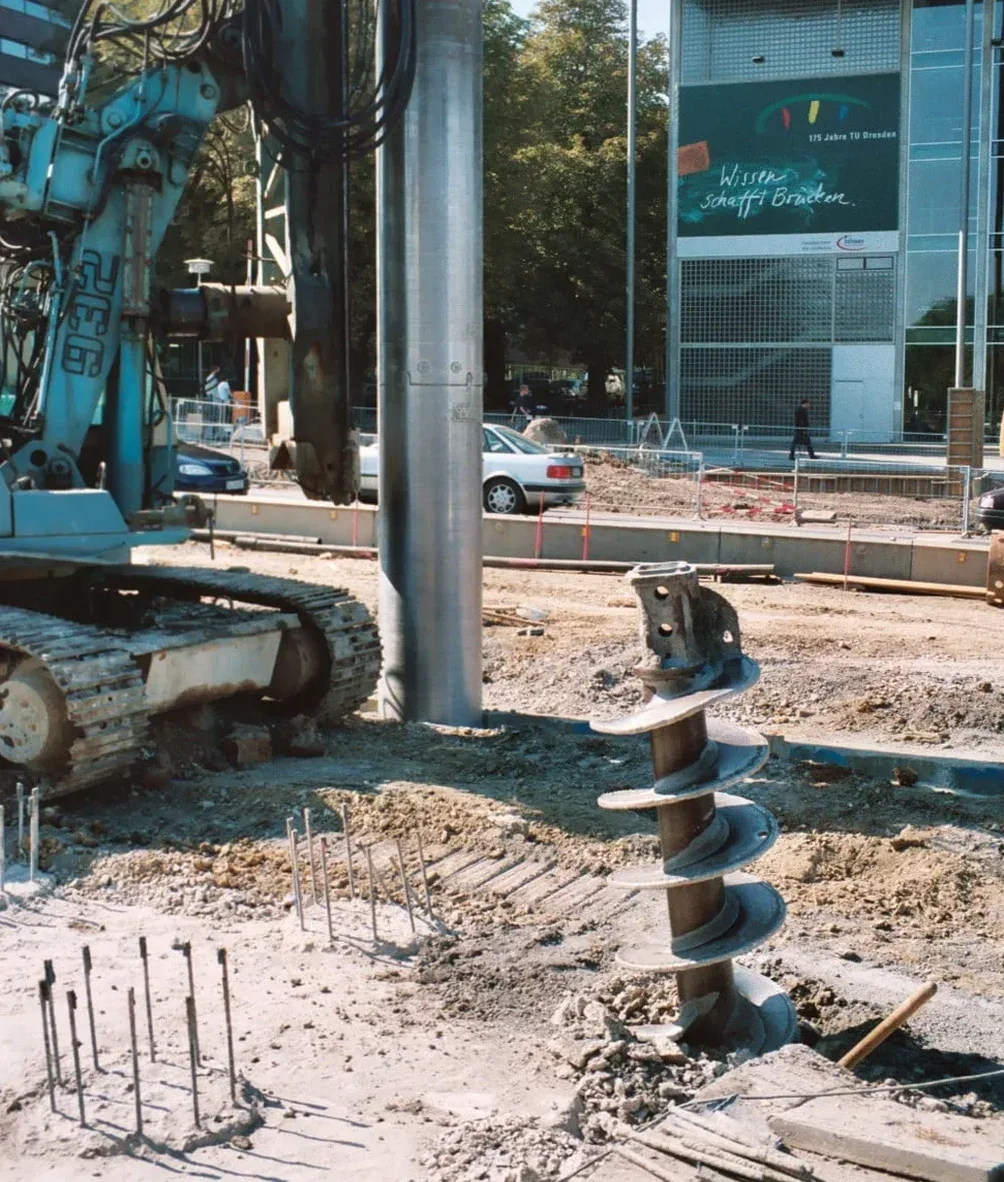
Our pile design workflow in Glendale covers the full lifecycle from feasibility through construction acceptance. We tailor the scope to the site's geology—whether it is a 50-foot CIDH shaft socketed into Verdugo granite or a group of driven H-piles in the alluvial basin—and deliver a sealed package ready for city plan check.
Geotechnical Investigation for Deep Foundations
Rotary wash and hollow-stem auger borings to depths of 60–100 feet, SPT sampling at 2.5-foot intervals, laboratory index and shear strength testing (UU, CU, direct shear), and groundwater monitoring to define the design soil profile for axial and lateral pile analysis.
Pile Capacity and Group Analysis
Static capacity calculations (α-method, β-method, Nordlund, O'Neill & Reese) for single piles; group efficiency and block failure checks; settlement analysis using equivalent raft or t-z methods; lateral response via p-y curves in LPILE or GROUP; CAPWAP analysis of dynamic test data.
Construction Inspection and Load Testing
Full-time observation during pile driving or shaft drilling and concreting; cross-hole sonic logging (CSL) and thermal integrity profiling (TIP) for CIDH shafts; static axial compressive load testing (ASTM D1143) and high-strain dynamic testing (ASTM D4945) with signal matching to confirm design capacities.
Common questions
What is the typical embedment depth for a driven pile in the Glendale basin?
In the alluvial area south of the 134 freeway, driven H-piles typically reach refusal in the Pleistocene Lakewood Formation at depths between 35 and 55 feet. We determine the exact tip elevation by tracking SPT N-values in the boring log—once blow counts exceed 40 blows per foot consistently over a 5-foot interval, we have a competent bearing layer. The final embedment is verified during driving with a wave equation analysis (GRLWEAP) and confirmed by PDA testing on initial production piles.
How much does a pile foundation design package cost for a Glendale residential project?
For a single-family hillside lot or small multi-family building in Glendale, a complete geotechnical investigation and pile design package—including two to three borings, laboratory testing, capacity calculations, lateral analysis, and a sealed design report—generally falls in the range of US$1,470 to US$6,540 depending on depth, access constraints, and the number of piles. Projects requiring a drilling rig on steep slopes, traffic control on major arterials, or static load testing will trend toward the upper end.
Do Glendale building officials require pile load testing for residential foundations?
The City of Glendale Building & Safety Division follows the 2022 California Building Code, which requires verification of design capacity by load testing or an approved alternative when the design is based on site-specific geotechnical data. For most residential projects, we satisfy this with high-strain dynamic testing (PDA) on a representative number of production piles, which is less disruptive and faster than a static load test while still providing the CAPWAP-calculated capacity curve the plan checker will want to see.
What is the difference between a drilled shaft and a micropile for hillside sites in the Verdugo Mountains?
Drilled shafts (CIDH piles) are typically 24 to 48 inches in diameter, require a larger drill rig with good access, and develop capacity through a combination of side friction along the socket and end bearing on competent rock. Micropiles are smaller-diameter (5 to 9 inches), can be installed with compact equipment on slopes where a full-size rig cannot reach, and transfer load primarily through grout-to-ground bond in the rock socket. For a steep lot in the Verdugos with limited access, we often recommend micropile groups because the drill can be broken down and walked onto the pad, and the bond strength in the weathered granodiorite is high enough to keep pile counts reasonable.
How do you account for liquefaction in pile design near the LA River?
In zones where the groundwater table is shallow and SPT blow counts fall below the liquefaction threshold, we run a Seed & Idriss simplified procedure to estimate the factor of safety against triggering at each depth. If liquefaction is predicted, we treat the liquefied layer as having zero skin friction and apply the full overburden as a downdrag load on the pile, per the neutral plane method. The pile section is then checked for combined axial and bending demands, and we specify a structural connection capable of accommodating the estimated settlement. In critical cases, ground improvement via stone-columns or deep soil mixing may be recommended to mitigate the hazard before pile installation.