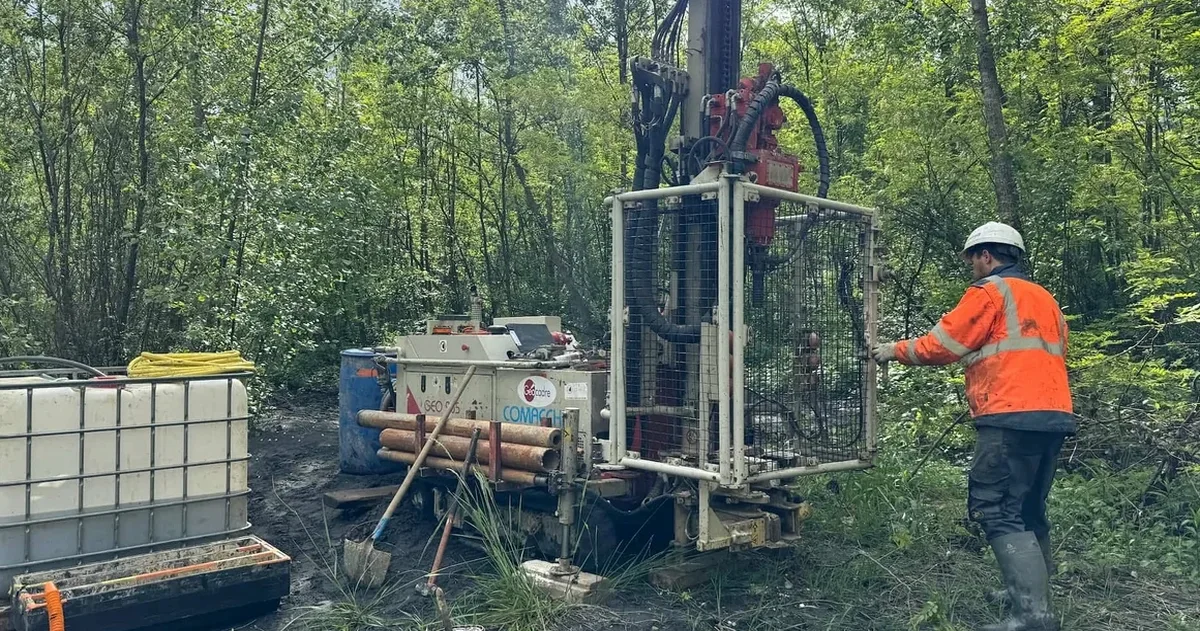
Glendale's building code, governed by the 2022 California Building Code (CBC) which adopts IBC with state amendments, mandates a thorough soil mechanics study for most new construction and substantial additions. The city's terrain—a transition zone between the Verdugo Mountains and the San Fernando Valley—creates highly variable subsurface conditions that demand precise geotechnical characterization. Our laboratory analyzes undisturbed samples to quantify shear strength, compressibility, and permeability, delivering the engineering parameters your structural team needs to design safe footings and retaining systems. We focus on practical, code-compliant reporting that moves your project through Glendale's plan check process without delays. For deeper stratigraphic profiling where penetration resistance governs foundation selection, the integration of SPT drilling provides standardized N-values that correlate directly with bearing capacity calculations per local practice.
Investing in a rigorous soil mechanics study upfront is the single most effective way to prevent differential settlement and earthwork disputes later in Glendale's demanding terrain.
Scope of work in Glendale California
Procedure video
Risks and considerations in Glendale California
Glendale sits at approximately 520 feet elevation along the seismically active Verdugo Fault zone, with the 1994 Northridge earthquake (M6.7) still serving as the benchmark design event for the region. Hillside lots with undocumented fill present a serious risk: saturated colluvium can lose effective stress rapidly under cyclic loading, triggering flow failures in cuts deeper than 12 feet. By omitting a comprehensive soil mechanics study, a developer accepts liability for foundation performance on materials whose strength can drop 40% or more when moisture content increases by just 5 percentage points. Our laboratory testing program quantifies the sensitivity of your site's soils to saturation and vibration, giving the design team the parameters needed to specify compaction requirements, subdrain networks, and reinforcement depths that keep the structure serviceable through the next major seismic event.
Our services
Our Glendale soil mechanics study integrates field sampling with laboratory testing to produce a clear picture of ground behavior. We offer two service tiers depending on the complexity of the site and the structural demands of the proposed construction.
Full Geomechanical Characterization
Includes consolidation, direct shear, and triaxial compression tests on undisturbed Shelby tube samples. Delivers bearing capacity, settlement magnitude, and lateral earth pressure coefficients for foundation design on Glendale's alluvial and hillside formations.
Index Testing Suite
Covers moisture content, Atterberg limits, grain size distribution, and unit weight determinations. Suitable for preliminary site assessments or smaller additions where the structural engineer requires classification and basic volumetric data to proceed with conservative assumptions.
Common questions
What's the typical cost range for a soil mechanics study on a standard Glendale residential lot?
For a typical single-family residential parcel in Glendale, a soil mechanics study generally runs between US$2,820 and US$5,820, depending on the number of borings, the depth of exploration, and the suite of laboratory tests required. Hillside lots with deeper bedrock or fill verification needs tend toward the upper end of that range.
How does consolidation testing affect my foundation design?
Consolidation testing (ASTM D2435) measures how much and how fast a soil will compress under sustained loading. In Glendale's alluvial basin deposits, this test identifies normally consolidated clays that could settle several inches under a new footing, allowing the structural engineer to specify a mat foundation or deeper embedment to mitigate the predicted movement.
Which shear test is appropriate for Glendale's stiff hillside soils?
For the stiff, overconsolidated silts and decomposed granite common in Glendale's hillsides, a consolidated-undrained triaxial test with pore pressure measurement (ASTM D4767) provides the most reliable effective stress parameters. Direct shear can be used as a screening tool for preliminary designs, but triaxial data gives the engineer the full Mohr-Coulomb envelope needed for slope and wall design.
What's the turnaround time from drilling to final report?
A standard soil mechanics study report is typically delivered within 10 to 15 business days after the field sampling is completed. Consolidation tests require longer because the specimen must be loaded in increments over several days to properly define the time-rate curve, so projects requiring settlement analysis should budget the full 15-day window.