Glendale's transformation from a quiet rail-served agricultural town into a dense urban node north of downtown Los Angeles has placed immense pressure on its transportation infrastructure. With a population exceeding 190,000 and major arterials like Brand Boulevard and the Ventura Freeway (SR 134) carrying heavy traffic daily, the structural integrity of pavements is not just a convenience but a core municipal concern. The alluvial fan deposits that slope gently from the Verdugo Mountains create a subsurface mosaic where fine-grained silts interlayer with coarser sandy lenses, leading to variable subgrade support that cannot be guessed at. In this environment, the laboratory CBR test provides the empirical backbone for any pavement design. When we run soaked California Bearing Ratio specimens in our lab, we are directly simulating the worst-case moisture scenario that a Glendale street will face during a wet winter, which is precisely what the Asphalt Institute and local Caltrans district standards require before approving a structural section. Our approach to the laboratory CBR test integrates data from initial field investigations to ensure the remolded sample truly represents the on-site conditions. For instance, understanding the particle distribution is critical, and we often pair this test with a grain-size analysis to confirm the fines content before compaction. The test itself, conducted strictly under ASTM D1883, measures the penetration resistance of a compacted specimen, giving us a percentage that directly correlates to the required pavement thickness. This is not a generic number; it is a geotechnical signature of how Glendale's native soil will behave under saturation and repetitive axle loads, and interpreting it correctly demands local experience with the city's specific alluvial stratigraphy.
A soaked CBR value isn't just a number—it's a prediction of how Glendale's saturated subgrade will distribute stress under braking trucks on San Fernando Road.
Scope of work in Glendale California
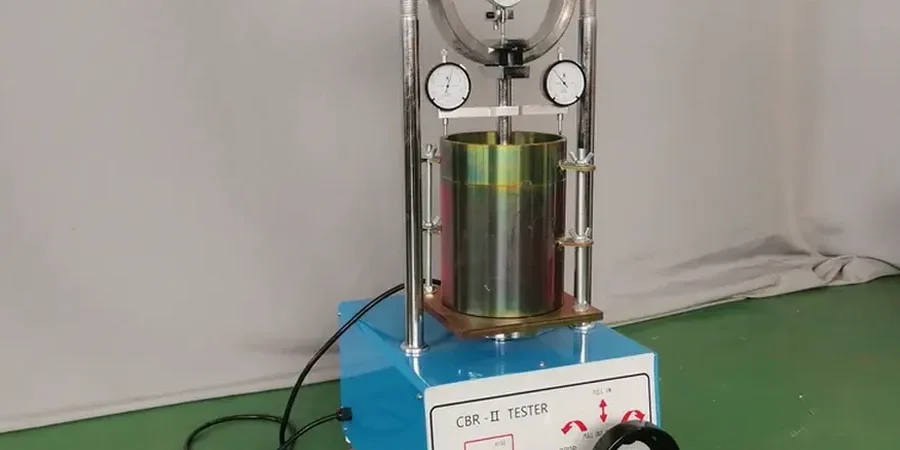
Procedure video
Risks and considerations in Glendale California
The risk of omitting a laboratory CBR test is codified in the IBC Chapter 18 and ASCE 7, which require a geotechnical investigation to characterize the load-bearing capacity of soils for any structure. In Glendale, where the city's building division enforces strict compliance with the California Building Standards Code (Title 24), a pavement design submitted without soaked CBR values is typically rejected outright. The primary geotechnical hazard in this area is the seasonal saturation of the upper subgrade; the alluvial soils can lose over 40% of their dry strength when fully soaked, a condition routinely overlooked by contractors who only test in-situ density. A pavement section designed on a presumed CBR of 15% that actually falls to 4% after a single rainy season will develop alligator cracking and subgrade rutting within two years, leading to a full-depth reconstruction that costs five times the original laboratory test budget. Beyond the financial liability, a failed pavement in a seismically active zone like Glendale—where the Verdugo Fault runs just north of the city—can compromise emergency vehicle access during a critical post-earthquake response window, turning a maintenance issue into a public safety failure.
Our services
Our laboratory CBR test program in Glendale is structured to provide a complete picture of subgrade performance, from initial sample preparation to final pavement design recommendations. We coordinate directly with local drilling crews to obtain undisturbed Shelby tube samples or bulk bags from the exact depth specified in the project's geotechnical boring plan.
Soaked and Unsoaked CBR Testing
We compact samples at optimum moisture per ASTM D1557 and subject them to a 96-hour soak to measure strength loss, reporting both the initial and saturated CBR values along with the swell potential. This is the standard requirement for Glendale's flexible and rigid pavement designs.
Subgrade Stabilization Verification
For sites treated with cement or lime to improve poor native soils, we perform laboratory CBR tests on the treated mix designs. We determine the optimal additive percentage by testing at several dosage rates and comparing the cured CBR strength gain against the project specification.
Common questions
What is a typical CBR value for native soil in the Glendale area?
In our experience testing alluvial deposits around the San Fernando Valley, native silty sands in Glendale typically yield soaked CBR values between 5% and 12%. Well-graded granular soils from the Verdugo Mountain foothills can reach 20% or more, while the clayey silts found in lower-lying areas near the Los Angeles River channel often test below 5% and generally require stabilization.
How long does a laboratory CBR test take from sample to report?
A standard soaked CBR test requires a minimum of five working days. This includes sample preparation and compaction (one day), the mandatory 96-hour soaking period, and the penetration test with data reduction on the final day. Expedited schedules can be arranged for urgent projects, but the soaking duration per ASTM D1883 cannot be shortened for a valid soaked value.
What is the cost range for a laboratory CBR test in Glendale?
A single-point laboratory CBR test on a remolded sample typically ranges from US$130 to US$190, depending on whether additional index tests like Atterberg limits or a full gradation are bundled. Multi-point programs for stabilization mix designs are priced based on the number of additives and curing times required.
Do you need a field density test along with the laboratory CBR?
Yes, the laboratory CBR value is correlated to a specific compactive effort and density. We recommend pairing it with a field density test, such as the sand cone density test, to verify that the contractor achieves the target compaction in the field. Without that verification, the laboratory CBR value does not accurately represent the as-built subgrade condition.