Glendale sits in a compressed tectonic bowl where the Verdugo, Sierra Madre, and Hollywood fault systems converge—a reality that changes how we approach every structural project. The city’s alluvial fan deposits, with groundwater perched within 30 feet across much of the central corridor, amplify long-period ground motion in ways that fixed-base designs struggle to handle. For mid-rise and essential facilities within the Glendale Redevelopment Area, base isolation isn’t an academic exercise; it’s how we decouple the superstructure from destructive spectral accelerations that exceed 1.2g at 1-second periods. Our team integrates site-specific seismic microzonation data with isolator prototyping to keep drift ratios below 0.5% even during the Maximum Considered Earthquake, as required by ASCE 7-22 Chapter 17.
A well-tuned isolation system in Glendale can cut base shear by 60 to 75 percent compared to a fixed-base design—but only if the soil-structure interaction model matches what’s actually under the footing.
Scope of work in Glendale California
Risks and considerations in Glendale California
We reviewed a six-story mixed-use project off Central Avenue where the geotechnical report flagged a soft clay lens at 15 feet, but the structural engineer had already locked in an isolation period of 3.0 seconds assuming a homogeneous stiff soil profile. The mismatch meant the isolators’ effective stiffness—calibrated for a shear wave velocity of 600 m/s—was reacting to a column where Vs barely reached 250 m/s. The resulting period elongation pushed the structure closer to the 2-second spectral peak, cutting isolation efficiency nearly in half. We had to re-run the nonlinear time-history analyses with 11 ground-motion pairs scaled per ASCE 7 Chapter 21, then redesign the lead core diameters to bring the displacement demand back within the moat wall clearance. Glendale’s plan check process now flags isolation projects for soil profile verification early, and that’s the right call—skipping it means the isolators become a compliance checkbox, not a life-safety system.
Our services
Base isolation in Glendale demands more than isolator selection—it requires a continuous loop between geotechnical data and structural modeling. The services we integrate into every project reflect where things go wrong when the loop breaks.
Isolator Prototype and Production Testing
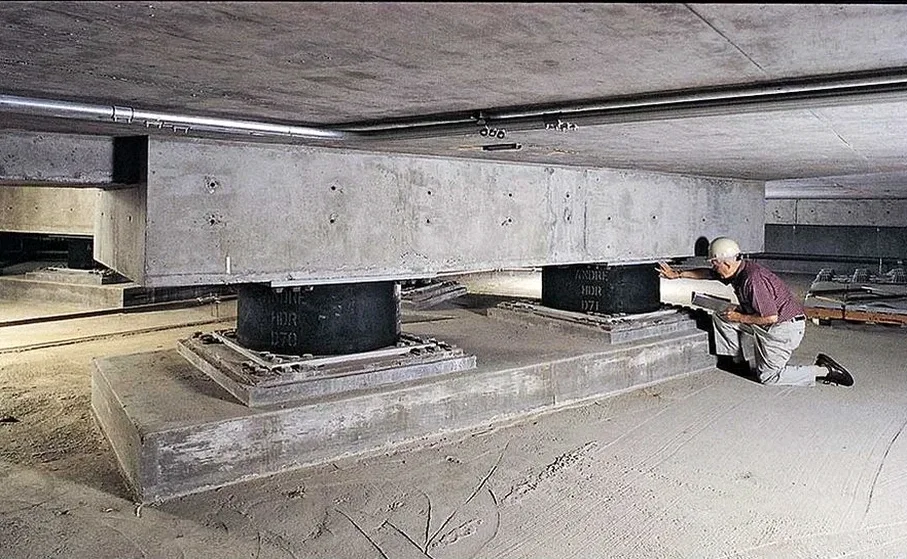
Full-scale cyclic testing of lead-rubber, high-damping rubber, and friction pendulum isolators per ASCE 7 §17.8.2, with three-cycle hysteresis loops at design displacement, maximum displacement, and total maximum displacement. We oversee production testing at the manufacturer’s facility and verify that bearing shear stiffness properties fall within ±15% of prototype values.
Soil-Structure Interaction and Time-History Analysis
Nonlinear response-history analysis using 11 ground-motion pairs (minimum) scaled to the site-specific MCER spectrum. We incorporate shear wave velocity profiles from downhole testing and run the isolated model through both service-level and MCE ground motions, reporting peak isolator displacement, base shear reduction ratio, and residual drift for peer review submission.
Common questions
What does base isolation design cost for a mid-rise building in Glendale?
For a typical 4- to 8-story structure in Glendale, the engineering design package—including nonlinear time-history analysis, isolator specification, prototype testing oversight, and peer review coordination—runs between US$4,820 and US$7,790. The total project cost is higher because it also includes isolator fabrication, installation, and the independent testing agency fees, but our scope covers the geotechnical-structural integration that Building and Safety requires before permit issuance.
Which isolator type works best in Glendale’s soil conditions?
It depends on the site class at the specific parcel. On the stiffer alluvial terraces north of Glenoaks Boulevard (site class C), friction pendulum systems provide reliable recentering with lower sensitivity to frequency content. In the central basin where site class D predominates, lead-rubber bearings often perform better because their hysteretic damping handles the softer soil amplification without driving the effective period too long. We always run site-specific ground response analysis before recommending a system.
How does the Glendale plan check process handle base-isolated structures?
Glendale Building and Safety follows the 2021 California Building Code (IBC), which classifies all isolated structures in Seismic Design Category D and above as requiring independent peer review. The review covers the ground motion selection, isolator prototype test reports, and the final design calculations. Plan check also verifies that the geotechnical report includes site-specific shear wave velocity measurements and liquefaction assessment, not just default ASCE 7 site coefficients.
Can I add base isolation to an existing building during a retrofit?
Yes, and we’ve done it on concrete frame buildings from the 1960s and 70s in Glendale. The process involves lifting the superstructure with hydraulic jacks, cutting the columns at a horizontal plane, and inserting isolators along with new transfer beams. The biggest constraint is usually the existing foundation system—we need to verify through test pits and coring that the footings can handle the concentrated isolator loads, which often means adding micropiles or grade beams before the isolation plane is installed. ASCE 41-23 governs the retrofit acceptance criteria.