The structural provisions in ASCE 7 and Chapter 18 of the IBC set the bar for ground improvement design, and in Glendale those requirements intersect with a particular subsurface reality. Much of the city sits on young alluvial deposits that washed down from the Verdugo and San Rafael Hills — silty sands and low-plasticity clays that look decent in a split spoon but compress more than expected under sustained footing loads. When column-supported floor slabs or shallow foundations need to carry more than 1,500 psf on these soils, stone columns become a practical alternative to deep piling. We run the CPT test first to map the compressible layer thickness continuously, then pair those readings with grain-size curves from grain size analysis to confirm the soil matrix will actually drain between the columns. For commercial pads near the Los Angeles River channel, we also check the liquefaction potential, because loose saturated silts at 15 to 25 feet show up more often than the published hazard maps suggest.
A stone column design lives or dies by the drainage path — if the silt between columns can't dissipate pore pressure during the first loading cycles, the composite behavior never kicks in.
Scope of work in Glendale California
Procedure video
Risks and considerations in Glendale California
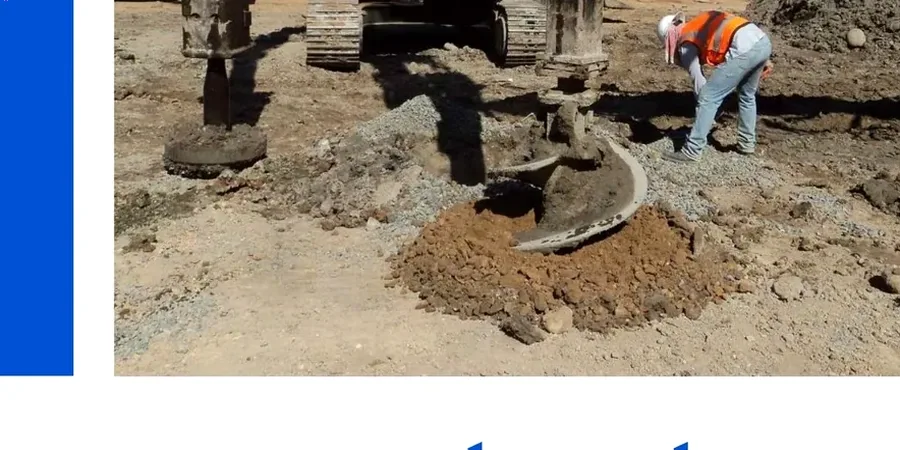
What we see repeatedly in Glendale is fill that looks uniform on the boring logs but hides pockets of uncontrolled material — old asphalt grindings, brick fragments, even decomposed granite hauled from a neighbor's cut. Running a stone column rig through that without probing first is asking for refusal halfway down the design depth. We probe the grid points with a cone or a small-diameter auger before mobilizing the vibrator. Another local pattern: the water table rises three to five feet after a wet winter, saturating the upper column zone that was designed dry. If the column material doesn't have at least 15 percent passing the No. 4 sieve, it loses confinement at the top. We spec a graded stone with enough fines to lock under repeated shear, and we verify the gradation with every 500 tons delivered.
Our services
Our work covers the full design-to-verification cycle for stone column projects in Glendale, from the initial subsurface characterization through post-installation acceptance testing.
Pre-design site characterization
We execute CPT soundings, SPT borings, and laboratory grain-size distributions to define the compressible layer geometry and the native soil's drainage capacity before column layout begins.
Stone column design and specification
We prepare the design package — column diameter, grid spacing, replacement ratio, stone gradation, and settlement estimates — sealed for city plan check under the current IBC edition adopted by Glendale.
Post-installation verification testing
We run plate load tests, inter-column SPTs, and modulus verification to confirm the treated ground meets the design assumptions and the project's settlement tolerance.
Common questions
How much does a stone column design package cost for a Glendale commercial building?
For a typical commercial lot in Glendale, the design package — including CPT soundings, laboratory testing, the design report, and a plate load test program — usually falls between US$1,290 and US$5,560, depending on the treated footprint and the number of verification points the city requires.
Which Glendale soil conditions make stone columns a better choice than deep foundations?
Stone columns work well when the compressible layer is less than about 30 feet thick and the native soil has enough fines content to provide lateral confinement. In Glendale's alluvial deposits, we see the best results in silty sands and low-plasticity clays where CPT tip resistance is between 5 and 15 tsf — soft enough to densify, firm enough to hold the column.
Does the City of Glendale require special testing for stone column acceptance?
The city follows IBC Chapter 18, which calls for verification testing on the improved ground. We typically run plate load tests at one location per 5,000 square feet of treated area, plus inter-column SPTs at select grid points. The testing plan gets submitted with the design package during plan check.
How long does the design and verification process take from start to finish?
Field work — CPT soundings and borings — takes two to three days on a standard Glendale commercial parcel. Laboratory testing runs about a week. The design report and sealed drawings are typically ready within ten business days after lab results come in, assuming no major surprises in the subsurface data.