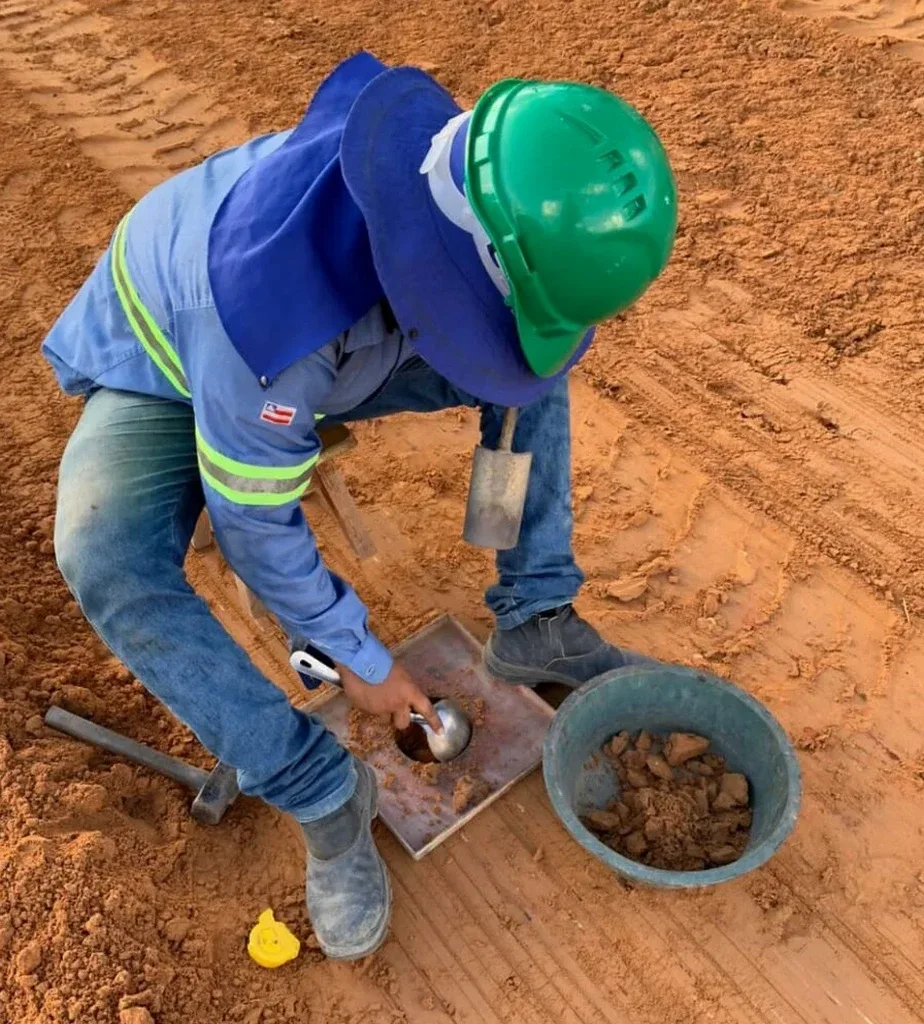
The most expensive mistake we see on Glendale job sites isn't a foundation crack—it's a failed compaction test that stops work for days while everyone argues about the result. In the hillside subdivisions north of the 134 and the infill projects downtown, soil conditions shift from decomposed granite to silty clay within a single block. When a field density test gets skipped or rushed, the consequence is almost always the same: a utility trench that settles six months after paving, a retaining wall backfill that drains into the neighbor's yard, or a slab that heaves after the first rainy winter. Our team runs sand cone density tests according to ASTM D1556, and we've learned that the difference between a passing result and a callback is usually how well the technician understands the site's moisture history. For Glendale's compacted fills—especially on sloped lots where compaction lifts are thin—we combine the field density check with a grain size analysis to confirm that the material being placed actually matches the approved borrow source specification.
A single failed density test on a fire access road in the Glendale hills can delay a final occupancy permit by two weeks.
Scope of work in Glendale California
The sand cone method remains the reference standard for earthwork because it directly measures volume—unlike nuclear gauges, which require site-specific calibration curves that drift in Glendale's heterogeneous fills. When the project involves deeper compaction verification, we often follow up with a CPT test to profile density continuously through thicker fill sections.
Risks and considerations in Glendale California
Contractors working in Glendale's older neighborhoods—particularly south of Glenoaks Boulevard where lots date from the 1940s—often discover undocumented fill that was placed without compaction records. We've pulled sand cone samples from backyards that tested at 78% relative compaction when the building code requires 90% minimum. That's not just a paperwork problem: that fill will consolidate under foundation loads, and differential settlement cracks appear within the first two years. The risk compounds on hillside pads where a partially compacted fill layer can act as a perched water table, saturating the overlying soil during winter storms and triggering shallow slope failures. A field density test program tied to the earthwork specification—with test locations marked on the grading plan and results reviewed by the geotechnical engineer before the next lift goes down—catches these problems when they can still be fixed with a sheepsfoot roller rather than an attorney.
Our services
Our field density testing program in Glendale covers the full cycle of earthwork quality control, from subgrade verification through final lift acceptance.
Compacted Fill Density Verification
Sand cone tests performed at specified lift intervals on building pads, roadway subgrades, and utility trench backfill. Each test includes moisture content determination and a comparison to the laboratory compaction curve for the approved on-site material.
Problem Fill Investigation
Targeted density testing on existing fills where no compaction records exist. We sample at multiple depths to map zones of under-compaction and provide the geotechnical engineer with data to design a remediation plan—whether that means over-excavation, deep dynamic compaction, or grouting.
Common questions
What does a sand cone density test cost on a typical Glendale residential lot?
For a standard single-family lot in Glendale, individual sand cone field density tests typically run between US$90 and US$170 per test point, depending on how many tests we perform in a single mobilization and the accessibility of the test locations. A full day of testing—which might cover 8 to 12 tests with a technician on site—is the most cost-efficient approach for larger grading operations.
How soon after compaction can you run the sand cone test?
The test can be performed immediately after the roller passes, as long as the surface is stable enough to place the cone plate without disturbing the compacted soil. There is no curing period required—unlike concrete testing—because we are measuring the mechanical density achieved by the compaction equipment. In Glendale's summer conditions, we do check that the surface hasn't dried and crusted over between the roller and the test, since that can affect the hole excavation and give an unrepresentative moisture reading.
How many density tests does the Glendale building department require?
The City of Glendale follows the IBC, which requires a minimum of one field density test per 1,500 square feet of each compacted lift, but the geotechnical engineer's report often tightens that frequency depending on the site's soil variability. On hillside lots with variable fill material, we commonly see specifications calling for one test per 1,000 square feet or one test per every 100 cubic yards placed. The final frequency is always set by the project's geotechnical consultant and approved by the city during plan check.