A common misstep we encounter with Glendale contractors is specifying a rigid pavement section based on generic county standards without accounting for the rapid soil transitions in the San Fernando Valley margin. Moving south from the Verdugo Mountains, the alluvial fan deposits shift from coarser gravels to finer silty sands within a few blocks, a condition that directly influences the modulus of subgrade reaction k needed for Westergaard edge stress calculations. Our team runs site-specific geotechnical borings per ASTM D1586 to calibrate the pavement thickness design, preventing the premature transverse cracking that occurs when a slab is placed over an uncharacterized non-uniform subgrade. Integrating this data with a CBR evaluation for roads ensures the base support aligns with the rigid layer’s demand for consistent vertical stiffness.
In Glendale alluvial fans, a 0.5-inch slab thickness increase without subgrade k-value verification can still leave you with a 20-year faulting problem.
Scope of work in Glendale California
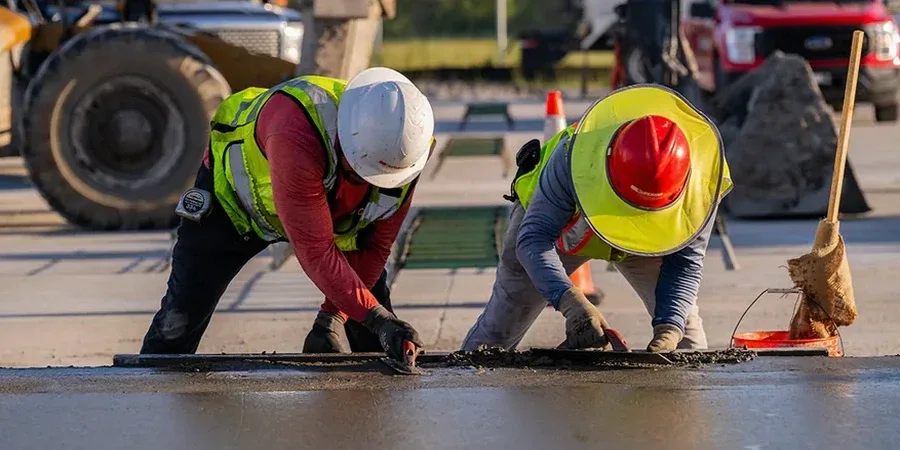
Risks and considerations in Glendale California
One thing we notice on Glendale arterial rehabilitation projects is that the existing asphalt overlay often hides a badly faulted concrete substrate. When the rigid pavement design doesn't include adequate dowel bar sizing for the actual truck traffic on corridors like San Fernando Road, the load transfer degrades rapidly, and the ingress of incompressible fines into open joints triggers spalling during the next heat wave. The IBC Chapter 18 requirements for expansive soil mitigation become critical here: a slab-on-grade over a moisture-sensitive clay subgrade without a properly graded capillary break will experience differential heave that no amount of reinforcing steel can fully restrain. Our field team has extracted cores from pavements only five years old that already exhibit map cracking because the mix design's water-cement ratio wasn't adjusted for the Santa Ana wind conditions during placement, accelerating surface drying shrinkage well beyond the 0.05% limit used in PCA design assumptions.
Our services
Our rigid pavement design support in Glendale covers the structural calculation and the field verification loop that keeps the constructed pavement matching the design assumptions. We handle two core scopes:
JPCP and CRCP Thickness Design
We determine the required slab thickness using mechanistic-empirical methods calibrated to Glendale’s traffic spectrum and subgrade variability. Outputs include joint layout, dowel diameter and spacing, tie bar specification, and terminal serviceability projections.
Subgrade and Base Characterization
Field testing program covering SPT borings, dynamic cone penetration, and plate load tests to establish the design k-value. We also run laboratory resilient modulus tests on subgrade samples to feed the MEPDG input for projects requiring Caltrans or FHWA review.
Common questions
What is the typical cost range for a rigid pavement design package in Glendale?
For a full design package covering site investigation, subgrade characterization, and structural thickness calculation for a typical commercial or arterial project in Glendale, the cost ranges from US$1,790 to US$6,320. The variation depends on the number of borings required to capture soil transitions, the complexity of the traffic loading (ESALs), and whether the review requires a full MEPDG submittal to the City of Glendale Public Works.
When do you specify doweled joints instead of aggregate interlock in Glendale?
We specify doweled transverse joints whenever the design ESALs exceed 3 to 5 million over the analysis period, or when the slab thickness exceeds 8 inches. In Glendale’s industrial zones along Flower Street, the heavy truck traffic makes aggregate interlock joints lose load transfer efficiency within the first few years, so dowels become the only reliable option to control faulting.
How do you account for Glendale’s expansive soil zones in the pavement design?
We map the expansive potential using Atterberg limits and the Expansion Index test per ASTM D4829. Where the plasticity index exceeds 25 or the expansion index is above 90, the design includes a moisture-conditioned subgrade layer at least 12 inches thick and a capillary break, plus a recommendation to extend the edge drains to prevent water ponding against the slab perimeter during the winter rains.
Does the design include a life-cycle cost comparison with flexible pavement?
Yes, for municipal projects we frequently run a life-cycle cost analysis comparing jointed plain concrete pavement against a full-depth asphalt alternative, using Caltrans-approved unit costs and a 40-year analysis window. In Glendale, the rigid option often shows a net present value advantage when the subgrade is competent and the traffic is heavy, because the maintenance intervals for asphalt overlays shorten significantly under the local heat loading.