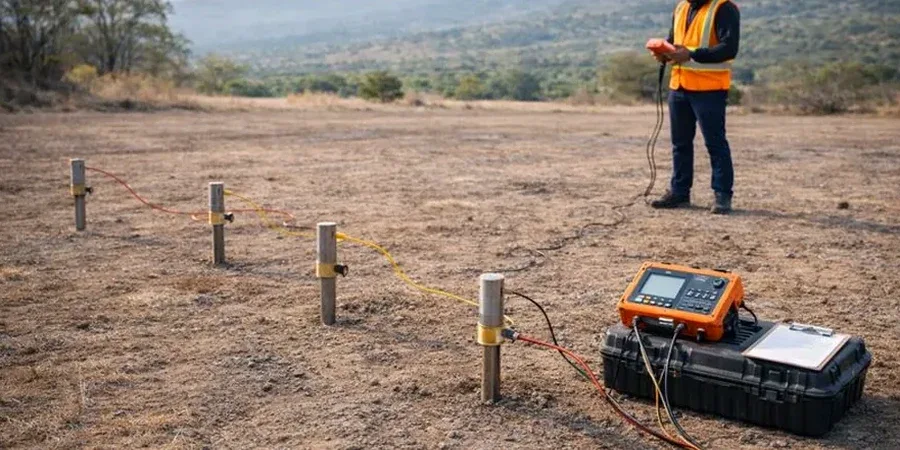
Glendale sits on a complex alluvial fan where the Verdugo Mountains meet the San Fernando Valley. The city’s 196,000 residents live atop interlayered sands, silts, and cobbles deposited by ancient runoff channels—materials that vary dramatically within a single lot. When a contractor hits unexpected groundwater or a buried boulder lens, the schedule takes the hit. We run electrical resistivity surveys to map these transitions before the backhoe arrives. A cpt test can verify low-resistivity clay zones with cone tip data, but the resistivity image gives you the big picture first. The method works by injecting current into the ground and measuring how the subsurface resists flow; wet clay reads low, dry gravel reads high. For Glendale projects near the Raymond Fault or the LA River channel, that contrast is what flags trouble.
A two-meter resistivity anomaly at the base of a footing excavation in Glendale has stopped more backhoes than a hard rain.
Scope of work in Glendale California
Risks and considerations in Glendale California
The most common mistake we see on Glendale projects is relying on a single boring to characterize an entire site. One SPT log on a half-acre lot gives you a point measurement; it won’t catch a sand channel or a buried utility trench crossing the building pad. We reviewed a case where a contractor hit saturated silt at 4 meters—three meters shallower than the geotech report predicted—because the boring missed a paleochannel that the resistivity profile flagged clearly. That one surprise added two weeks of dewatering and a revised shoring design. Resistivity soundings spaced on a grid, or run as a 2D ERT line, connect the dots between boreholes. In the Verdugo alluvium, where grain size can shift from clay to cobbles in 20 meters, that continuity is what keeps the excavation plan predictable. The cost of the survey is trivial next to the cost of a stopped job.
Our services
We run resistivity programs that fit the scale of the job—single-point soundings for a small lot, 2D ERT lines for linear infrastructure, and combined geophysical packages when the subsurface is especially tricky.
Vertical Electrical Sounding (VES)
Single-point depth soundings that map resistivity versus depth at key locations. Ideal for footing investigations, groundwater depth mapping, and bedrock profiling on residential and light commercial lots in Glendale.
2D Electrical Resistivity Tomography (ERT)
Multi-electrode lines that produce continuous cross-sections. We use these for pipeline alignments, slope stability investigations along the Verdugo front, and detecting lateral changes in fill thickness.
Combined Resistivity and SPT Verification
Resistivity data calibrated with one or two targeted borings. The geophysical image guides where to drill, and the drilling logs confirm the resistivity interpretation—reducing the total number of borings needed.
Groundwater and Contamination Mapping
Resistivity contrasts help delineate the water table, perched zones, and conductive leachate plumes. Useful for environmental site assessments and dewatering design in the LA River watershed.
Common questions
How much does an electrical resistivity survey cost in Glendale?
For a typical Glendale residential or light commercial lot, a single VES sounding runs between US$700 and US$990. A 2D ERT line with multiple electrodes will be higher, depending on line length and site access. We give a fixed-price scope before we mobilize so there are no surprises.
What depth can a resistivity survey reach on a Glendale hillside?
Depth depends on the maximum electrode spread. With a 50-meter Schlumberger array on a hillside lot, we typically resolve layers down to 20–25 meters. In favorable conditions—dry surface, good electrode contact—we can push deeper. The Verdugo Mountains weathered bedrock usually shows a strong resistivity contrast around 8–15 meters in the foothill neighborhoods.
Can the resistivity method tell me if I will hit groundwater during excavation?
Yes, groundwater is one of the strongest resistivity contrasts in the shallow subsurface. Saturated sands and silts read much lower than dry overburden. We have mapped perched water tables in the Glendale alluvium at depths as shallow as 3 meters. The survey gives you a depth range to expect water, which lets you plan dewatering before you dig.
How long does it take to get results?
Field acquisition for a single VES sounding takes under an hour. We process and invert the data the same day and deliver a preliminary resistivity log within 24 hours. A full report with interpreted cross-sections and correlation to any available boring logs follows within three to five business days for most Glendale projects.