A five-story mixed-use project on Brand Boulevard hit a snag when preliminary borings revealed highly variable alluvium: lenses of loose sand interbedded with stiff clay just 15 feet below grade. The structural engineer initially specified isolated footings, but the geotechnical report flagged a high potential for differential settlement exceeding one inch across the building footprint. The fix was a rigid mat foundation designed to bridge the soft spots, distributing column loads so the entire slab settles uniformly. In Glendale, where subsurface conditions can shift dramatically within a single lot due to the Verdugo Wash's historic sediment deposition, raft foundation design is not a fallback option; it is often the most economical solution when you factor in the cost of over-excavation, deep ground improvement with stone columns, and schedule delays. Our team integrates data from in-situ SPT drilling to calibrate subgrade reaction moduli directly to field-measured N-values, avoiding the generic assumptions that undermine performance on sites near the Raymond Fault zone.
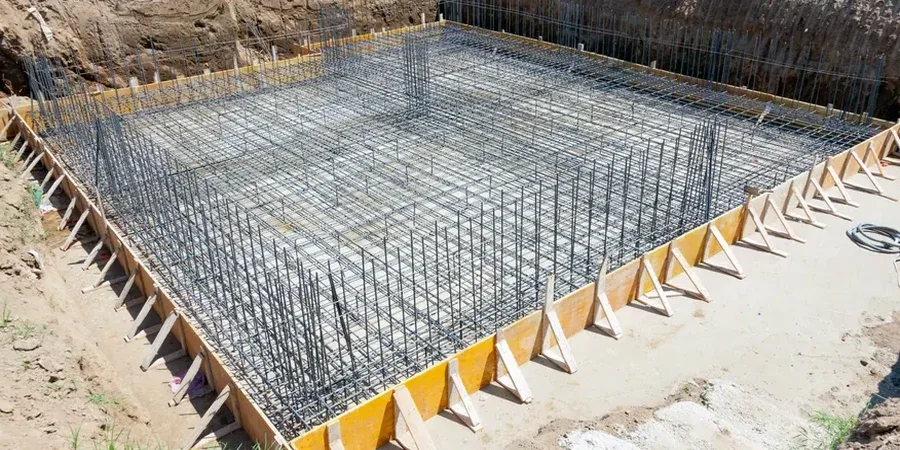
A mat foundation converts differential settlement risk into a controlled, uniform movement that protects the structural frame from distress.
Scope of work in Glendale California
Risks and considerations in Glendale California
The most expensive mistake a Glendale developer can make is treating a mat foundation as a thick slab-on-grade and skipping the geotechnical investigation. We have seen projects where an under-designed mat, poured directly over uncompacted fill without a properly engineered subgrade, tilted 3 inches over 60 feet within the first rainy season, cracking the floor slabs and jamming elevator rails. In seismic country, a mat that is not designed for the kinematic demands of the site—ignoring the spectral acceleration at the fundamental period of the soil deposit—can amplify rather than attenuate ground motion, transferring excessive shear into the column bases. Another common failure is underestimating the uplift forces on the mat's perimeter when a shallow water table rises after a series of atmospheric river storms; without a drainage blanket and a verified factor of safety against flotation, the entire structure can become buoyant. Our risk assessment explicitly models these scenarios using the site-specific response spectrum and the groundwater monitoring data that the City of Glendale requires for projects exceeding 5,000 square feet of new foundation area.
Our services
Our mat foundation package covers the full engineering workflow from initial concept through construction support, tailored to Glendale's plan-check requirements.
Geotechnical Site Characterization
Focused drilling, sampling, and laboratory testing to define the soil profile, compressibility, and shear strength parameters that govern mat foundation performance under the specific stratigraphy of the San Fernando Valley basin.
Soil-Structure Interaction (SSI) Analysis
Three-dimensional finite element modeling of the mat, subgrade, and superstructure to evaluate differential deflections, internal slab moments, and the transfer of seismic base shear through the foundation interface.
Mat Foundation Structural Design and Detailing
Production of IBC-compliant construction documents including mat thickness, top and bottom mat reinforcement schedules, shear reinforcement at column capitals, and embedment details for lateral force-resisting elements.
Construction-Phase Subgrade Verification
On-site observation and testing of the prepared subgrade using nuclear density gauge and proof-rolling, ensuring the achieved compaction and moisture conditioning match the design assumptions before the concrete placement begins.
Common questions
What is the typical cost range for a mat foundation design in Glendale?
For a structural mat foundation design package covering geotechnical input, SSI analysis, and structural detailing for a mid-rise building, the engineering fees generally range from US$1,040 to US$3,910 depending on the building footprint, number of columns, and complexity of the soil profile. This does not include the cost of the geotechnical field investigation itself.
When is a mat foundation preferred over isolated footings?
A mat foundation becomes the superior choice when the allowable soil bearing pressure is low (under 2,500 psf), when columns are closely spaced making individual footings overlap, when differential settlement must be minimized for sensitive equipment or finishes, or when the structural system requires a rigid diaphragm at the base to resist seismic overturning moments uniformly.
How does the City of Glendale plan-check handle mat foundation designs?
The Glendale Building & Safety Division reviews mat foundations under IBC Chapter 18 with a strong emphasis on the geotechnical report's recommendations. The plan-checker will verify that the design bearing pressure is supported by the report, that the structural drawings show both top and bottom reinforcement clearly detailed, and that a special inspection statement is included for the continuous observation of subgrade preparation and concrete placement.
What soil parameters are most critical for a mat foundation analysis?
The modulus of subgrade reaction (kv) is the most influential parameter, but it is not a soil property—it is an interaction parameter that depends on the mat stiffness and the soil's stress-strain behavior. We derive it from plate load tests or SPT correlations and adjust it for the full-scale mat dimensions. Equally critical are the undrained shear strength for short-term bearing capacity, the compression index and recompression index for consolidation settlement calculations, and the low-strain shear modulus (Gmax) for seismic SSI analysis.