Glendale's development arc, from its early railroad-driven expansion to today's dense Verdugo foothill subdivisions, has always wrestled with water. The historic alluvial fans spreading south from the San Gabriel Mountains left a complicated subsurface where clay lenses sit abruptly against coarse gravels, and where groundwater perched on weathered bedrock can throw a construction schedule into disarray. When you’re sinking a retaining wall off Mountain Street or excavating a basement near the 134 freeway corridor, generic lab data won’t tell you how fast water actually moves through the formation. Our field permeability test (Lefranc/Lugeon) measures that directly, providing the in-situ hydraulic conductivity values that Glendale’s plan check engineers and geotechnical reviewers expect to see before they’ll sign off on dewatering plans or shoring designs. We run these tests alongside slope stability assessments where hillside saturation is the trigger, and we often pair them with test pits to log the stratigraphy right at the test interval.
The Lugeon test reveals whether rock fractures dilate or wash out under pressure — insight that a lab perm alone cannot provide.
Scope of work in Glendale California
Risks and considerations in Glendale California
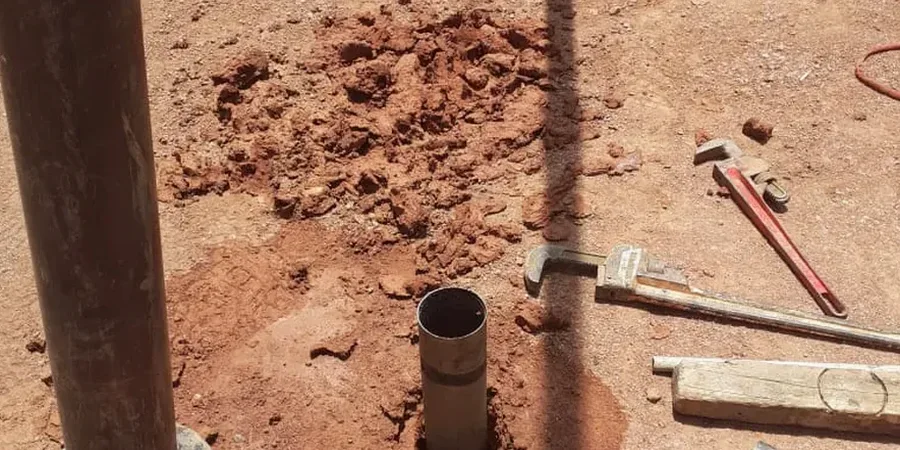
The test setup itself tells the story of local risk: we lower a slotted PVC screen and bentonite-sealed packer assembly into a borehole drilled through Glendale’s typical sandy silt overburden, isolating the test zone so we’re not just measuring filter cake permeability. If the packer seal fails against the rough sidewalls of a San Rafael diorite borehole, the injected water shorts straight to the surface and the test is void. That’s the practical reality crews deal with on a 100°F August afternoon in the Crescenta Valley. The bigger risk, of course, is what happens when you skip the test entirely. Overestimated permeability means undersized dewatering, flooded excavations, and CalOSHA stop-work orders when trench stability fails. Underestimated values lock the owner into an overbuilt drainage system that nobody needed. Our test protocol — pre-soaking, three to five repeat runs until stabilization, and real-time barometric compensation — strips out the noise so the engineering decision rests on a defensible number, not a guess.
Our services
Our field testing program in Glendale is designed to give contractors and design engineers the hydraulic conductivity data they need without delaying the project schedule. Both test types run from the same drill rig setup, letting us switch protocols based on what the formation gives us.
Lefranc Borehole Permeability Test
Variable-head and constant-head testing in soil and weathered rock. We isolate the target horizon with inflatable packers, run multiple head cycles until K stabilizes, and deliver a report with corrected conductivity values, test interval logs, and groundwater level data. Ideal for dewatering design in Glendale’s alluvial basin projects.
Lugeon Rock Mass Permeability Test
Five-stage pressure testing in fractured crystalline or sedimentary rock following the Houlsby method. Each stage measures apparent Lugeon units and reveals fracture flow regime (laminar, turbulent, dilation, washout). Essential for tunnel pre-excavation grouting programs, dam foundation assessments, and deep hillside retaining structures anywhere in the Verdugo Mountains foothills.
Common questions
What does a field permeability test cost in Glendale?
A single Lefranc or Lugeon test interval typically ranges from US$710 to US$1,140, depending on depth, access conditions, and whether we’re already mobilizing a drill rig for your geotechnical investigation. The cost includes packer setup, water supply, data acquisition, and the final interpreted report. Mobilization, traffic control permits within Glendale city limits, and any extended standby time are quoted separately once we review your site location.
When is a Lugeon test required instead of a Lefranc?
The Lugeon test is the appropriate method whenever the test interval is in fractured rock — granodiorite, gneiss, or sandstone where discontinuities control flow — rather than in soil or completely weathered material. If the borehole encounters rock with an RQD below 50%, a Lugeon test will capture the fracture network’s hydraulic behavior, whereas a Lefranc test would only reflect the matrix permeability, missing the dominant flow paths.
How long does a single test take?
Plan on one to two hours per test interval once the borehole is drilled and the packer is set. A Lefranc variable-head test requires several fill-and-drawdown cycles until the stabilized K-value converges; a Lugeon five-stage test requires injecting at stepped pressures for 10 minutes per stage. If the formation is very tight or very open, the time can shift either direction.
How do you compare Lefranc results to lab permeability tests?
Lab permeability tests — like a flexible-wall permeameter on a Shelby tube sample — give you the matrix conductivity of a small, disturbed specimen. Our field Lefranc test measures a much larger soil volume in its natural stress state, including macro-features like root holes, gravel lenses, or fissures. The field value is almost always more representative of how the ground will actually behave during dewatering, and Glendale’s plan reviewers generally prefer the field data when it’s available.
Can you run the test in a cased borehole?
Yes, and in Glendale’s collapsible alluvium it’s often necessary to case through the upper 10 to 20 feet to keep the hole open before testing deeper. We case to just above the test interval, then advance open-hole to the target depth. The packer is set in competent ground above the test section, so the casing itself does not interfere with the measurement.