The subsurface profile beneath Glendale shifts dramatically depending on which side of the Verdugo Fault you're on. Near the San Fernando Valley floor, you'll encounter deep alluvial deposits where a CPT rig can push through interbedded silts and sands with remarkable stratigraphic precision. Move up toward the foothills of the Verdugo Mountains, and the cone starts registering refusal on weathered granitic bedrock much sooner than expected. In our experience, this contrast is the single most important factor in foundation design here. A test pit can help verify near-surface fill conditions, but for quantifying the continuous shear wave velocity and tip resistance needed for seismic site classification, the CPT provides data that discrete sampling simply cannot match in these transitional geology zones.
In Glendale's alluvial corridor, a misclassified Site Class can alter your seismic base shear by over 30%, making continuous CPT profiling a non-negotiable step before structural design.
Scope of work in Glendale California
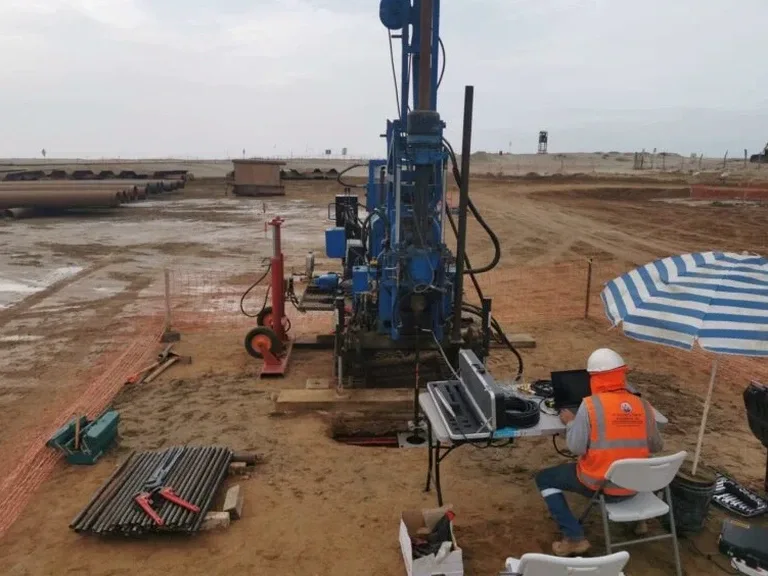
Risks and considerations in Glendale California
Glendale's rapid expansion during the post-war boom placed thousands of structures on alluvial fans without modern geotechnical characterization. Many older commercial buildings near Brand Boulevard sit on potentially liquefiable soils that were never evaluated with high-resolution methods. The historical 1971 San Fernando earthquake demonstrated how varying sediment thickness amplifies ground motion differently across short distances, a pattern we still see reflected in current microzonation maps. Skipping a CPT investigation on a redevelopment site risks underestimating the cyclic stress ratio required for liquefaction triggering analysis. Without continuous tip resistance and sleeve friction data, thin critical layers of loose sand can be entirely missed by standard boring programs, leaving a hidden weak plane directly beneath the proposed footing elevation.
Our services
Our CPT program in Glendale integrates directly with your broader geotechnical investigation, providing the continuous data stream that complements laboratory testing and discrete sampling:
Seismic CPTu (SCPTu)
Combines piezocone penetration with downhole shear wave velocity measurements, essential for ASCE 7 Site Class determination in Glendale's alluvial zones.
Liquefaction Triggering Analysis
Uses CPT-based simplified procedures (Boulanger & Idriss methodology) to calculate factor of safety against liquefaction for each soil layer encountered.
Stratigraphic Cross-Sections
Generates continuous soil behavior type (SBT) logs using normalized charts, ideal for correlating multiple CPT soundings across commercial development parcels.
Consolidation & Settlement Profiling
Measures pore pressure dissipation to estimate coefficient of consolidation (cv) directly in situ, improving settlement predictions for mat foundations on soft clays.
Common questions
How much does a CPT test cost for a standard residential lot in Glendale?
For a typical single-family residential parcel in Glendale, a standard CPT sounding generally runs between US$170 and US$280 per test location, depending on required depth and whether seismic modules are needed. Deeper commercial soundings or sites requiring multiple dissipation tests will shift the scope and the final investment.
Can CPT testing replace soil borings for foundation design in Glendale?
In many cases, yes. CPT provides continuous stratigraphic data that exceeds the resolution of standard borings. However, for Glendale sites where the cone encounters refusal on shallow bedrock or where undisturbed samples are required for laboratory testing, we recommend a hybrid approach combining CPT soundings with selective borings.
How long does a CPT field investigation take?
A single CPT sounding to 80 feet in Glendale's typical valley sediments takes approximately 45 to 90 minutes. Adding seismic modules adds about 15 minutes per test interval. Most residential sites are completed within a single morning, while larger commercial parcels with multiple soundings may require a full day of field work.
Do I need CPT testing if my Glendale property is on bedrock in the foothills?
If you're in the Verdugo foothills where weathered granite is shallow, CPT may not be the right primary tool because refusal occurs quickly. In those cases, we typically rely on rock coring and seismic refraction for Vs profiling. However, if your property sits on the colluvial apron between the mountains and the valley floor, CPT can map the variable thickness of transported soils overlying the rock with excellent precision.